Thursday, February 11, 2016

APO ISLAND, Philippines -Marine Turtles

Apo Island, Philippines -off the coast of Negros Oriental Feb 10, 2016

Apo Island is the little dot off the boot.
But seeing the turtles makes this a really special trip.


The outrigger's mate

We approach a small beachfront on an outrigger aimed for the tiny island of Apo off the southern coast of Negros Oriental.  The draw is a Marine Turtle Sanctuary.  Four Chinese tourists an older couple in their 50s and their son and daughter-in-law share this 6 seater as we get buffered by the waves and sea between Malatapay, Negros and Apo.  Many Chinese tourists await boats as we sit at the pier in Malatapay.  We note their amazing choice of wardrobe for their turtle viewing experience.

Onesies for snorkeling


Like pop beads in the 50s


A 45 minute trip with an outrigger engine makes one appreciate the manpower it took to ride these waves before gasoline powered outboard motors.

The Filippino captain a sun darkened,wiry,seaman focuses straight ahead to the point of population along the beach at Apo.  The many orange life vested Chinese tourists are a gay splotch in the sand and surf ahead.  The engine cut, the mate jumps ashore and muscles the boat into harbor, tying it on the rocks.  A cordoned off area on the beach designates the turtle sanctuary and several local guide shops await the outpouring of tourists planning to view the native species that still hang out here among the throngs of Chinese New Year seeking tourists.


We skip the snorkeling guides and find a small shaded spot along the far end of the beach to launch our snorkeling activities outside the roped off "sanctuary."  Rob goes in first while I guard the camera and day tripping possessions in our backpack on shore.  Soon he is waving and telling me,"You have
to come in. There're  turtles."  He trades posts with me and I don the snorkel mask and head out into not exciting coral but deeper water than the sanctuary bound markers.  I am enjoying the waving movement of the coral, the bright neon blue little fish, the blue starfish clinging to the sea floor, a school of angelfish, a blowfish and an eel squirming back into it's cave, and figure that is a pretty good display of marine life.  No turtles but a nice little snorkeling experience.

So I slowly turn and head back toward the beach. All of a sudden in a movement to my left, a gentle flowing brown mass appears and I realize a green turtle is swimming alongside me.  I am amazed at the buoyancy and effortlessness in which it moves and its total lack f concern for my large presence in its space. It outstretched its leathery neck and nips a piece of food from the coral below, totally at home in its environment and I feel like a privileged voyeaur.  Then a smaller turtle perhaps a few years old comes floating by and I am delighted at seeing the pair. I breathe evenly through the mask floating as they do in the waves and realize a oneness with them.  I can't help but think of the turtle totem the Native American Indians revere them as a go between Mother Earth above and the seas below.

The town is a small enclave totally at peace with this inflow of tourist economics. After a lunch of fresh caught tuna fish grilled , Rob walks around to take pictures of the town while I find some shade.   It is totally laid back except for the hordes of tourists who coalesce within the cordoned off area.
Those who can not swim are drug around by their Filippino guide while  clinging to a life ring . We await our outrigger who takes us back to the mainland before the seas get really choppy and we leave with impressions of coral swaying on the sea floor and turtles floating above.

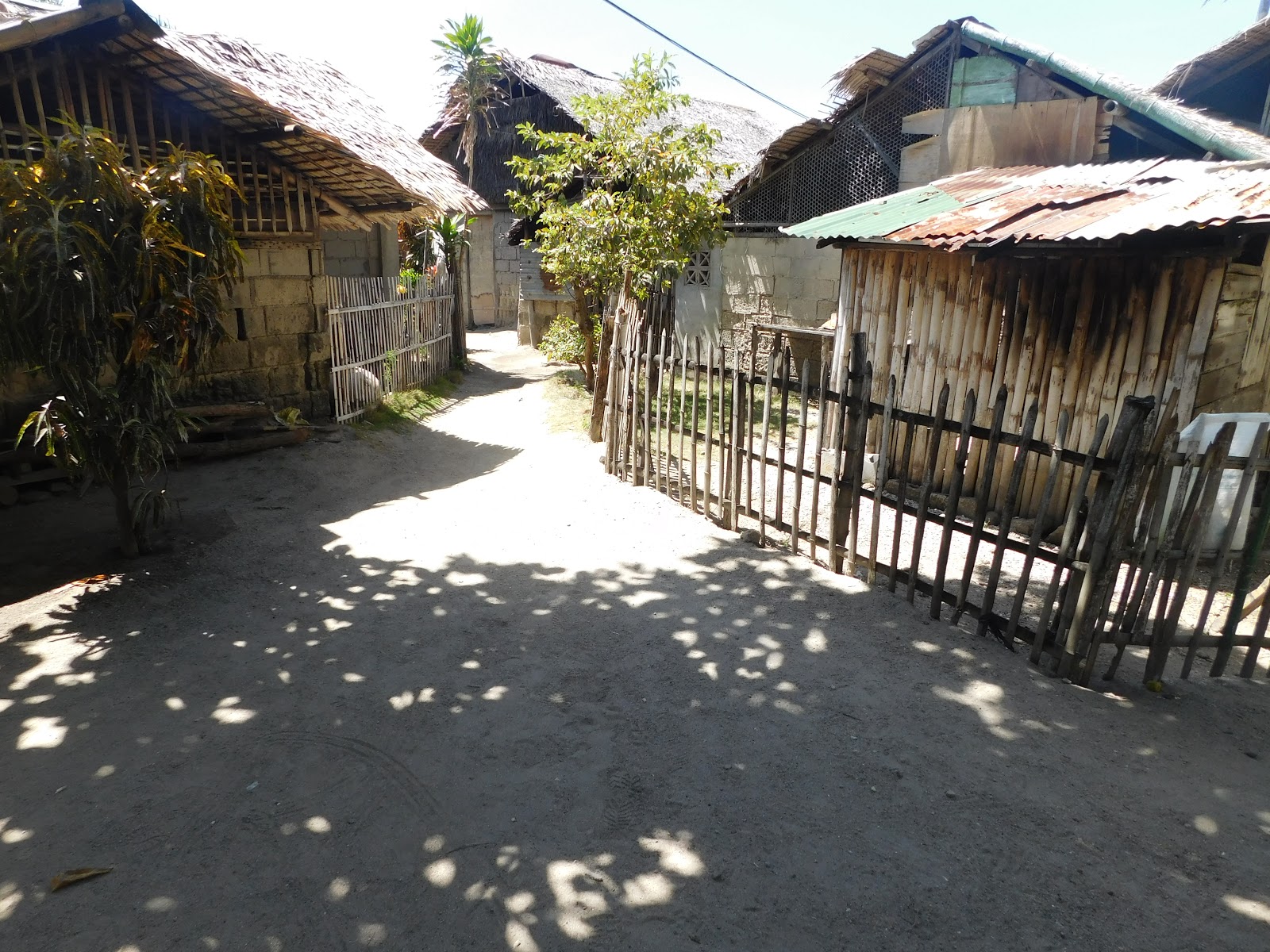


native fish trap


A native son


Kids happy to see you.


Apo Village overlooking the coast.


A piece of shade.


Fate awaits.


Idyllic calm seas close to shore.


Sarawak, Borneo around Gunung Mulu National Park

SARAWAK, Borneo


THE PEOPLE
The gentle and kind nature of the reserved Malay people comes across as we traveled the Western side of Borneo in Sarawak at Gunung Mulu National Park and along the west coast beaches of Sabah. The Muslim call to prayer in their Masjids awakes one from slumber at 5am to turn over while the faithful men make their way to the mosque and face Mecca 5 times daily intoning prayers to Allah.  

It seems too foreign to Westerners this separation of male and female and the clear social division that exists between the sexes as required by the Muslim religion. Women do not talk with men outside the family.  I approached an older Muslim man wearing a prayer cap in the coastal town of Kota Belud, sitting under a tree in the square to ask directions.He studiously ignored me, acting as though he did not hear my "Excuse me sir."  

The older women seem to appraise us with an expressionless face, hiding their judgment and distancing themselves from us Western females. While the younger women are quicker to show a smile and  acceptance or curiosity, it takes a lot longer for the older ones to warm to our Western presence.  One gets the feeling that they think It is best to ignore us or at least keep their distance and opinions of our Western clothing and its' flaunting of skin to themselves.  I watch the men very surreptitiously check out Jenny's long legs and her blonde hair unfettered by a hajib.  They look at her like they do not look at their own women. There is a subtle judgment, male appraisal and often a hooded dismissal that suggests they are ambivalent as to how they should respond.  Yet they seem to still check her out  because she is Western, young blonde, tall and good looking.  They are much more circumspect with Kellyn because she is clearly with Erik. Unlike India there is not the leering from men but a certain distanced quiet appraisal.

I am told by a friendly massage therapist in Kota Kinabalu that Christians outnumber the Muslims in Sabah, a surprising fact until one gets out into the countryside. It seems that every few miles one sees yet another small church, St. Peter, St. Paul, etc. that unites a community. Clearly Magellan was followed by  the Spanish missionaries, first. 
 to claim land and souls, they made significant headway converting these locals to Christianity, a religious overlay that worked here in the jungle much as it did in the Southwest of the US among the Indian populations along the Rio Grande. 

Back to my masseuse, she shared with me that she has lived with her boyfriend for 7 years, an offshore oil and gas worker and that many young women come to the city KK to live lives that are not necessarily approved of by their more traditional families.  She also shared that the Muslims do not come for massage, just Christians, Buddhists and tourists in KK.  

Development in the Countryside
 Seaside and riverine habitat meets rain forest and jungle where once indigenous peoples lived off the land and nomadic tribes moved following food sources.  Now Sabah's jungles are highly developed and the food source for larger mammals, coconut palms,bananas and the most diverse habitat for jungle species in the world has been replaced by the homogeneity of palm oil plantations.  We flew over unending miles of rows and rows of palm trees which have supplanted much of the inland rainforest. Much of the jungle has been subdued in Sabah's inland territory.  Development and economic success here means subduing the rain forest, cutting it down and replacing it with the mono species that spells Malaysian ringits for the shrewd 'landowners' who have done the deals with development enterprises on once tribal and/or unclaimed jungle.  

Consequently much of the native habitat of the indigenous peoples and animals is gone.  The orangutans and probiscus monkeys which Borneo jungles were so famous for are now largely only found in very limited reserve areas that are thin ribbons of nature surrounded by miles of Palm oil plantations.  There are only a few opportunities to really see orangutans outside of the rehabilitation centers,  and because it is the fruiting season they do not need to venture close to the waterways where boats might easily bring tourists to put them on display.  This is the only way we were able to see about a dozen probiscus monkeys on a tour we joined with 2 busloads of Chinese tourists who had all come to see the nosy monkeys and the evening fireflies along the river bank.  We ended up opting not to see the orangutans at all because it would have take a flight across country and another boat trip to maybe see them in the wild around Sandakan, the area now famous for the Nov 2015  beheading of a Malaysian engineer taken hostage by nearby Philippinos.  WEehave seen orangutans in the San Diego zoo so we left it at that.   

Coming next.... the beaches of Borneo were terrific.
Sands wept secluded Borneo  beaches without the hordes of sun seekers. Quiet little beach getaways with backpacker vibes around the tip of Borneo, Kudat and off the shore of Kota Belud, western side of Sabah.  

Monday, March 16, 2015

ChristChurch, Cricket and Paua Shells

Dropping into the South Island of Christchurch New Zealand we were visiting a city 3 years post earthquake with a serious reconstruction agenda and lots of parking lots.  Much of downtown Christchurch was leveled during their 2011 earthquake and if you are in construction you can make your fortune on the hundreds of work crews that are rebuilding this city from their Central Cathedral to the many homes that were affected by this 6.30 major tremor.   Over 187 people died and they had up to 300 subsequent tremors over the year that followed.  Talk about jangling the nerves of a population.   Given all that, the people are exceptionally friendly, laid back and welcoming.


Our day had started with an overnight flight from Melbourne, which landed at 5am in Christchurch waaaaaaay before anyone was even thinking about getting up and starting their day.  The taxi dropped us at the Burger King downtown thinking it would be the first business to open at 7am.  So we huddled in the eave of the building next store and got a sense of what it would be like to be homeless.  Our motel check in time was 2pm and we were hoping for an early check in.  ( Luckily we had pre-booked! )

We milked our Burger King Flat Whites (coffee) and breakfast till about 9am and then headed off with our wheelies in tow to see if we could check into our City Center Motel.  “Nope, No way.  Didn’t you know The International Cricket Championship Opening is tonite? We have no openings and need to clean the rooms.  2pm is the best that could be accommodated.”  We were given a city map and figured we would zombie our way thru the day checking out the sights and come back at 2pm.


After a rest under the huge pines in Hagley Park, (more like a collapse), we headed to the nearby Canterbury Museum and Botanical Gardens.  The highlight for us was the Paua Shell House which they have managed to reassemble a portion of inside the museum. Mabel and Fred a couple that lived their lives on the souther tip of NZ collected paua shells.  To keep from going crazy with the isolation and the wind, Fred polished them as a hobby.  As he became more enthusiastic about his hobby, the paua shells began to pile up on the floor.  To save their marriage and so Mabel didn’t have to vacuum around them, they decided to hang them on the walls.  They filled the walls of their living room with over 1000 paua shells and all  matter of the bric-a-brac  collected over a lifetime crowded every available surface.  We were so enamored with the zany artfulness of it all we couldn’t help ourselves. When Fred and Mabel passed away their children, rather than fight over the division of the paua shell,  donated the home to the museum.  What a great slice of seashore heaven it proved to be. 


So if you are otherwise  looking to fill your day in Christchurch you stroll thru the Botanical gardens and conservatory, which were lovely. 


Finally a little punting down the river might be in order if you wish to engage a boat to woo your significant other whilst on a slow romantic punt, which we skipped. 


 The container mall is a very ingenuous use of shipping containers, employed to continue retail affairs whilst the town is being rebuilt.  We strolled thru the many different shops and eateries in the container mall, all railroad car size enterprises, had some lamb kabobs and ginger beer and just got into the pace of NZ.


Like small towns in Australia, it is  a bit like dropping back into the 60’s.  Slow paced, easy going and pleasant.  It is almost a “nary a care in the world” kind of psyche here, where no matter what employment the New Zealander is in from shop clerk to gas station attendant,  (yes they still have these), everyone has the time to take the time to be friendly and stop and chat.  And chat as long as you wish about the most mundane things.  A best restaurant, the directions, the  rebuilding of the city, the sport of cricket  etc….  It is so refreshing not to be in a totally screen obsessed reality and really interact with people who just want to be engaging. 


As an additional little bonus surprise,we happened upon the opening of the International Cricket Championship Opening Celebration that first  night we arrived and thousands of  cricket crazed Kiwis filled their Hagley Park to watch the opening festivities and cheer on their Kiwi Team –The Blacks.  Music, a parade, the participating country teams, speeches and all other manner of crowd pleasing fun was had by the attendees, wrapping up with fireworks.


In bed by 11pm we had the longest two days jetlagged and zombified but totally quirky and interesting in the start of our NZ South Island adventure.  What lays ahead??

Tuesday, February 10, 2015

Tasmania: A Lot of Highlights and A Few Disappointments


Just finishing up our last day in Tasmania.  What a surprise this country has been.  The people are wonderfully friendly and gracious.  The country is really well developed with cattle and sheep graziers and lots of farming, potatoes, corn and other food stuffs.  The coastline is gorgeous and we have spent a lot of time on it going from beach to beach.

Highlights of our 9 day trip here were:

·      Port Arthur- a convict settlement south of Hobart that was the first place to establish a population center on the island.  Convicts were sent here from England, Ireland, Wales to do hard labor and clear the forests, build houses and roads and every kind of manual labor imaginable.  Some for many years others for a few before they were released.  Conditions were grueling and overseers could be sadistic and kept people locked in totally dark cells in isolation for days on end for the slightest infringement.   Eventually they had to build an asylum for those that could not mentally coup after being released from solitaire.


The buildings left behind at Port Arthur detail the tough conditions these early settlers were subjected to working all day in, damp and cold conditions clearing forests and spending their nights in seclusion in jails barely big enough to lay down and equally cold and damp.  It is surprising so many actually lived to see their freedom granted and to go on to settle Australia or return back to New England. 


·      Wineglass Bay- on NE coast it is a truly lovely beach that you come to after a rather arduous walk up the mountain 45 minutes to a viewing point and then a serious walk downhill (1 hour) knowing you will have to return and walk up the mountain again.  Thus it discourages the faint hearted and so there are very few people on the beach.  The bay is about as picturesque as one could ask for the sandy beach is clean.  While some ventured into the surf we were content to lay in the sun on the sand and enjoy the peace.  We stayed in a cabin in a little camper van park at the National Park entrance near Coles Bay and it reminded us of the little cabins we rented in Rocky Mt. Park when the kids were small. 

·      Devil’s Corner- A Tasmanian Sauvignon Blanc from the Tamar Valley in the North Central part of the state was a delightful respite at the end of the day.  Tasmania has become quite a center for boutique little vineyards and this one was named after a part of the beach where ships were want to wreck offshore.  The vineyards are beautifully kept and like most of Tasmania, from apples to pine trees, planted in regimented rows and kept up as a matter of pride and economic return.


·      The Air BnBs that we have rented have been mostly FABULOUS. What a GREAT idea.  We have had a number of good ones. The first one was in Torquay off Bell’s Beach a surfing mecca near Melbourne and was fabulous.  The second was above a pub and  hotel  that was built in the 1850’s for seafarers.  It was dated and pretty rustic but the convivial noise floating up from the bar and the incredible meal of lamb and fresh vegetables was one of the best in all my travels.   The Acacia BnB also an Air BnB was a beautiful old house in the midlands of Tasmania  at Sheffield where we stayed in a 4 poster king bed and shared it with 2 delightful traveling boomer couples from this part of the world.  The gardens and the house were picture perfect and the breakfast an array of local foods. 


We are now in Sandy Bay near Hobart at an amazing little studio apartment that has a grape arbor outside our door and a 3 story garden running up the side of the hill, full of every kind of plant one can imagine, overlooking the Sandy Bay.  You can’t compare these experiences to a stay in a motel or hotel.  Just the best!


·      The beaches are amazing.  While a bit too cold to swim in they are gorgeous and some venture out.  But the sand and long expanses of beaches are terrific.  There were so many as we traveled along the east and northern coast.  We went to one up in a reserve with an aboriginal name called Narwantapu and it was almost deserted and absolutely beautiful. The harbors and ports are active and picturesque and still support many fishing fleets that work out of them.

Bakers Beach Narawtapu National Park

The flora and fauna are the outstanding highlight as there are weird and unusual trees like the palm trees in this mountain environment that look like Dr. Seuss trees, lots of different beech and gum trees, a pine tree called King Billy, a really different flora and fauna than


we have seen anywhere else in the world. 


Disappointments were:
·      Cradle Mountain- Tassies and travel books make a big deal about this national park.  It’s great that it is a national park as it saves the ecosystem of this unique mountainous Tasmanian environment.  It is really the only mountain of any significance in Tasmania with the exception of the Asbestos Range.  That’s right we took a dirt road right through the latter.  Don’t know why they call it that. It was dry and generally uninteresting but a shortcut to where we were going.
However, being from the Rocky Mountains we are so spoiled.  There are at least a hundred walks that are more appealing than Cradle Mountain right outside our back door.  


Outside America Tasmania has some of the tallest trees in the world.  After they die they stand for 70-100 years as there are no termites and they are so heavily oil rich that they resist deterioration and rotting. So you see lots of dead tree hulks across the countryside.    Of course,  they also have several of the most poisonous snakes in the world one of which we literally walked over before Rob stopped to photograph it leaving his bare ankles exposed for a bite.    It was a 3 foot long black tiger snake that is highly poisonous.  (And Jenny did not want me to bring my snakebite kit. )

·      Tasmanian devils the little night moving carnivore with sharp canines are dying off of facial cancer.  They are trying to segregate the unaffected population on an island off the coast of Tasmania and keep them healthy to reintroduce back onto the mainland.  The true Tasmanian tiger of a dingo like size is now totally extinct and has only been seen in infrequent and undocumented sightings in the far NE corner of the island. 
·      The Roadkill is rampant. You see a lot of of wombats, wallabies and and echidnas with a few kangaroos that have met their end on the roadways.  The amount of road kill is a telling story of the fact that now the main predators of these species are mostly man and their automobiles.


I have to say there has not been much that we did not enjoy about Tasmania.  Rob took a few hard knocks from time to time but survived them well.  


We would highly recommend it for others to explore and travel here.