Sunday, March 5, 2017

Colombia-Cartagena-Santa Marta-Los Naranjos-Minca 2017

Colombia- Cartagena, Santa Marta, Minca, Los Naranjos-2017

The birds call and roosters cock-a-doodle-do piercing the quiet of early morning. Another day unfolds. Women move into the kitchens, brewing  coffee and starting breakfast. Sidewalks are swept of leaves and the prior day’s detritus and beaches are raked clean. The business of commerce and of building roads, housing, fixing the never ending list of things that break down and need replacement or repair, cleaning, washing, dressing the kids in their uniforms for school, families readying for the day, begins. Colombians, a busy, friendly people, move at the pace this equatorial climate demands, slow and methodical.


Getsemanie- Cartagena Street Art


Tourists like us wake up slowly. The long day awaits to be filled with our diversions: sightseeing, lazing around in hammocks, on beach chairs, in restaurants, and under shaded porticos, hiking to sights up the beach or on a dusty jungle road where the next sight awaits to be captured in our memory. Our photos yield colorful sunsets, beaches awash in translucent waves, friendly faces, monuments, churches, prehistoric and contemporary art in museums and in the streets, birds, abundant tropical plants, coffee plantations, waterfalls tumbling down clear, jungle streams, offering cool waters to rinse the dust of the road off. 

The sun reaches its zenith, baking the earth, until most withdraw after lunch to find respite in a siesta.  Colombia temperatures are about the same year around from 85-90 degrees.  We were here in the dry season before the April rains and it was very dry, dusty and hot.


Gold- God, greed and glory were the drivers that brought the Spanish to these shores.  The search for gold, and a monarchical desire to expand dominion were the dominant goals. The missionary zeal to save souls and convert the heathens to Catholicism, the one true faith, blessed the conquest. Colonial interests in Spain soon vied with France, England, the Netherlands for first come-first dominion of these new lands in the misnomered “Indies.” The Spanish were the conquistadors here and almost everywhere in South America. 


They brought their Catholic religion to those Indios left after the ravages of the diseases they transported into these lands, the indigenous people having no immunity. The majority of the natives were wiped out and those that survived were enslaved to toil for their conquerors. Gold that had served as status adornments, reflecting the art and beauty of the Indios was melted down into Spanish doubloons and sent back to fill the royal coffers of the Queen in Spain.


The culture of an indigenous people who had survived centuries was wiped out in less than 50-100 years.  


Indigenous Art- Gold and Clay Pots.  Jewelry and funerary urns.


The scourge of civilization had arrived. Santa Marta, where we spent two weeks in the surrounding environs,  is the oldest continuously occupied European settlement in all of South America, a port from which the Spanish came and went and conquered their Caribbean dominion and from here moved inland. 


Guns and cannons were no match for hatchets and poisoned arrows.

Spanish Fort at Cartagena


Ahh…for the love of God!  So churches were built with slave labor, Indians subdued, fortifications from pirates planned and erected to defend the colonial homeland from usurpers and protect the spoils of their conquest.


The many indigenous Indians were ‘subdued.’ The business of converting the Indios grew.

The coastal Tayrona Indians now have a National Park set aside on their homelands. Typically they open up it to campers and tourists who wish to Explore the beach and jungle here. Originally this had been our reason to visit this part of Colombia, but we arrived to find that it was closed for one month for spiritual cleansing.  So we went with the flow and enjoyed the adjacent beach and jungle outside the Park. They deserve to make their own rules on their lands. So we bowed to their wishes ( really no choice), small consolation for them in the grand scheme of things.


Statues of Tayrona Indians and some interlopers.


A bit of a pirate reenactment here…think stealing Spanish plunder. 


We beached it at a rather high-end resort for three nights feeling decadent even though the price was equivalent to a Holiday Inn in the States.


The path to the beach was a 5-minute walk through a jungle of fruit-banana, lime, pineapple, mango, papaya and avocado, as well as heliconia and lovely tropical flowers.


Villa Maria-our hotel in Los Naranjos near the beach.


Then it was time to move inland. We headed to the selva-jungle outside of Santa Marta higher up in the mountains, where the temperatures dropped 10+ degrees and the bird life increased a hundred fold. Minca a small little tourist oasis offered a few nights in a former convent at Hotel Colonial Minca which had 8 rooms. Having originally been assigned a cell, when the key did not work, we luckily were reassigned.


The hammocks and the “cell.”  


Coffee grows wild on the slopes.  One can see how Juan Valdez and his burro are the best way to pick it.


We ended up in what must have been Mother Superior’s room, spacious with a small refrigerator and with such luxury, felt quite comfortable.  The peaceful countryside was punctuated with the jar of buzzsaw and hammering as the Hotel Colonial Minca was expanding during the day. We were forced to get up and out during the day and take our siesta in the hammock to the banging of nails into bamboo for the new palapa roof. Expanding for tourism. Our taxi driver returned from Santa Marta up the steep, winding road to pick us up two days later, as promised. We asked the driver who came from Santa Marta to pick us up for our return, if there were plans to continue paving the road farther on. He noted they were soon to pave the road farther up to the top of the mountain. His experience was that tourism would move on with the pavement to the top of the mountain overlooking Santa Marta. Lo, the Convent would not be as enticing to tourists, even without buzz saws and hammers.


We took a walk for about 1.5 hours uphill and 1.5 hours back to the Sierra Nevada Cerveceria and La Victoria Coffee plantation tucked up in the hills. It was a long, hot, dusty hike up the road. The jungle along the road is covered in dust. This going concern was the excuse for hikers, motorcyclists and 4x4s to find a destination with coffee freshly picked and processed, or the local Sierra Nevada brew, freshly made. I enjoyed coffee at the La Victoria facility and the Happy Toucan brew later in Santa Marta.


Bamboo forest grows tall


Oro- White Coffee Beans at La Victoria Coffee Plantation


The plantation also is the center of the Sierra Nevada brewery. The Happy Tucan and the Happy Jaguar are two of their four brews. This little hut is where the beers are brewed and sent to Santa Marta about 30 miles away.

A Sierra Nevada stream flows through the brewery.


Pozo Azul- a cascading stream and waterfall, is a tourist attraction. Twelve tourist buses were parked there on our way up the mountain to La Victoria. We stopped on our return when they were all gone in the afternoon and had it virtually to ourselves.

We ended our walk back with a walk down the canyon to the river that supplies the water for the Sierra Nevada beer and all the residents of the area.  A cool dip as refreshing as the beer.


Back down to Santa Marta, preparations are being made for Carnival, at the start of Lent. What a commercial scene.

Rob was considering this “charming ensemble.” But, alas, we will miss Carnival, Fat Tuesday and the week’s celebration that follows as we return home on Saturday.

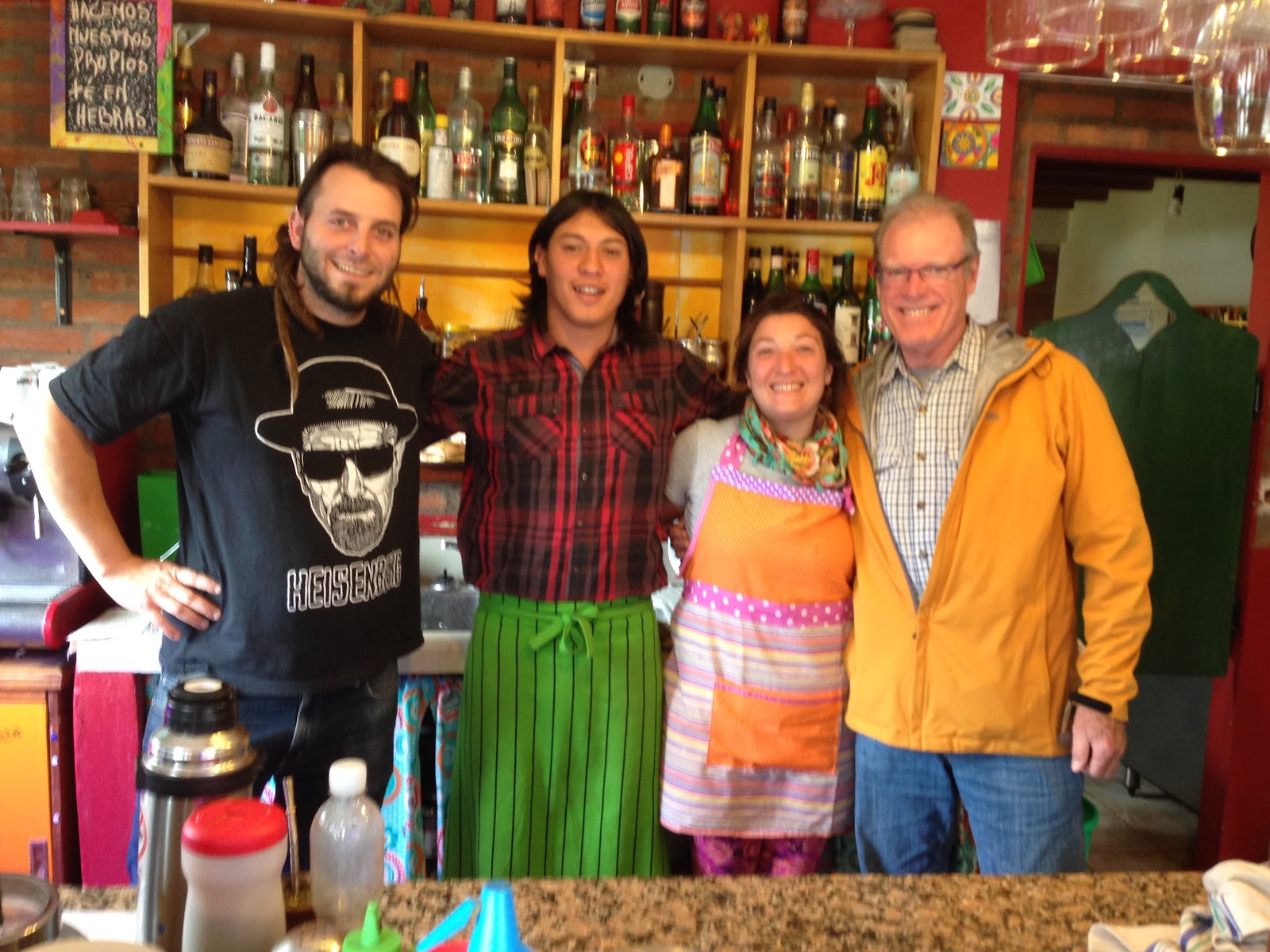
So we have one last night in Santa Marta before returning to Cartagena and then home.  I will close with some photos of the beautiful Colombian people, just living life.
                 
Tinto, a sweetened coffee, sold on the streets. 
 Watch repairman works from a street cart.

    My favorite- the tuna bicyclist!


Lovely ladies of Cartagena

Street Rappers in Cartagena.  


Boca Grande- modern Cartagena in the distance behind a beach-side soccer field.

 Fresh fish abundant but still pricey compared to other food.  Tuna, dorado, shrimp, squid and many others were great dinner fare.


Family living in a hut on the beach selling bebidas-drinks.


Street vendors everywhere selling fresh fruit. Watermelon, mango, papaya, tangerines, limes.
Fruit vendor- dressed for tourists in Cartagena.  
Leo Uribe- Our Air BnB host in Cartagena


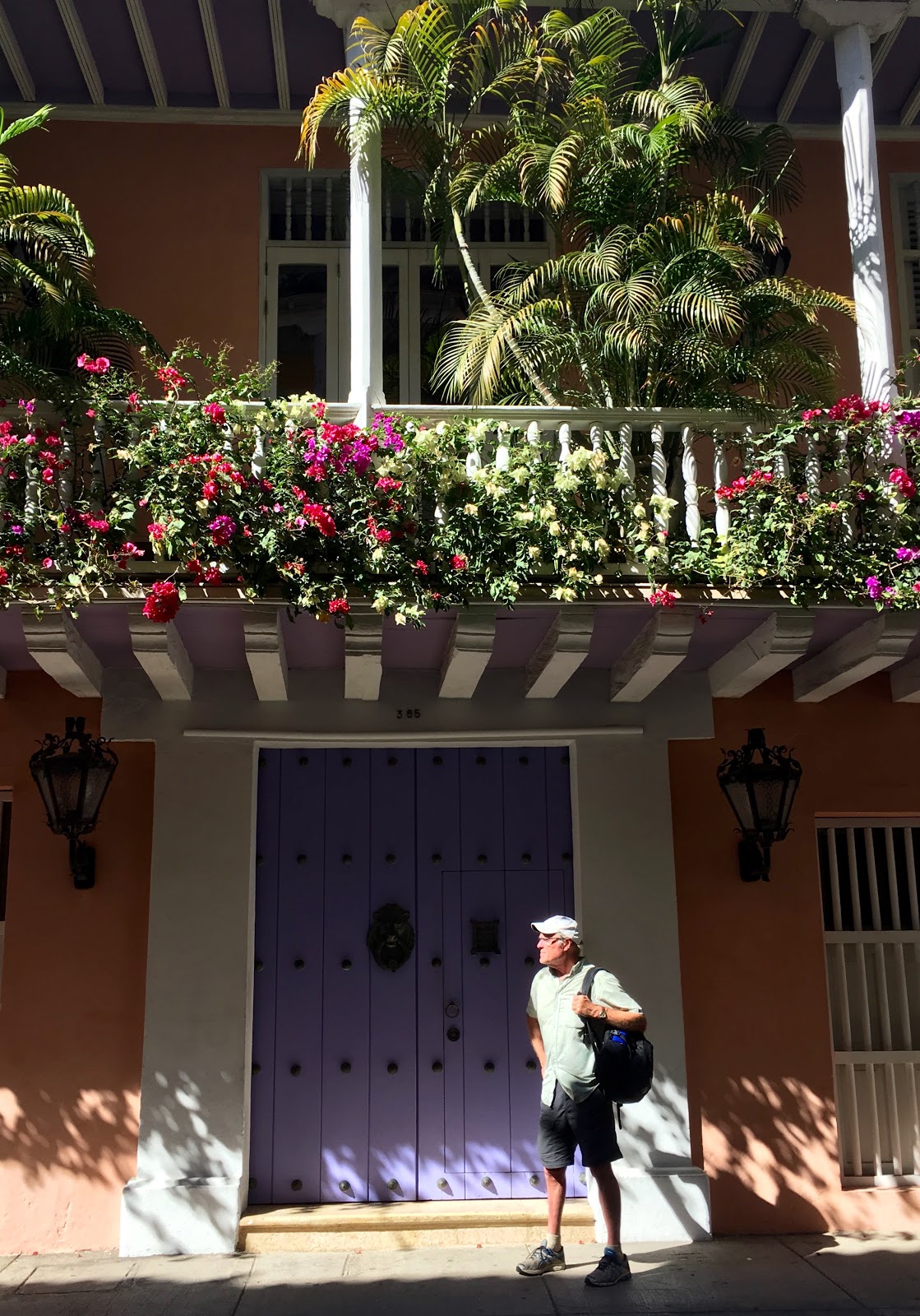
Zaguans are doorways of haciendas built for protection
and high enough to ride a horse into.
As this was only the Northeastern Carribean coast of Colombia that we visited in two weeks, we will have to return.


Beautiful old hacienda doors –zaguan- in Cartagena’s  Historical Center.


Saturday, February 11, 2017

Thoughts on Patagonia


Thoughts on traveling in Patagonia, Argentina

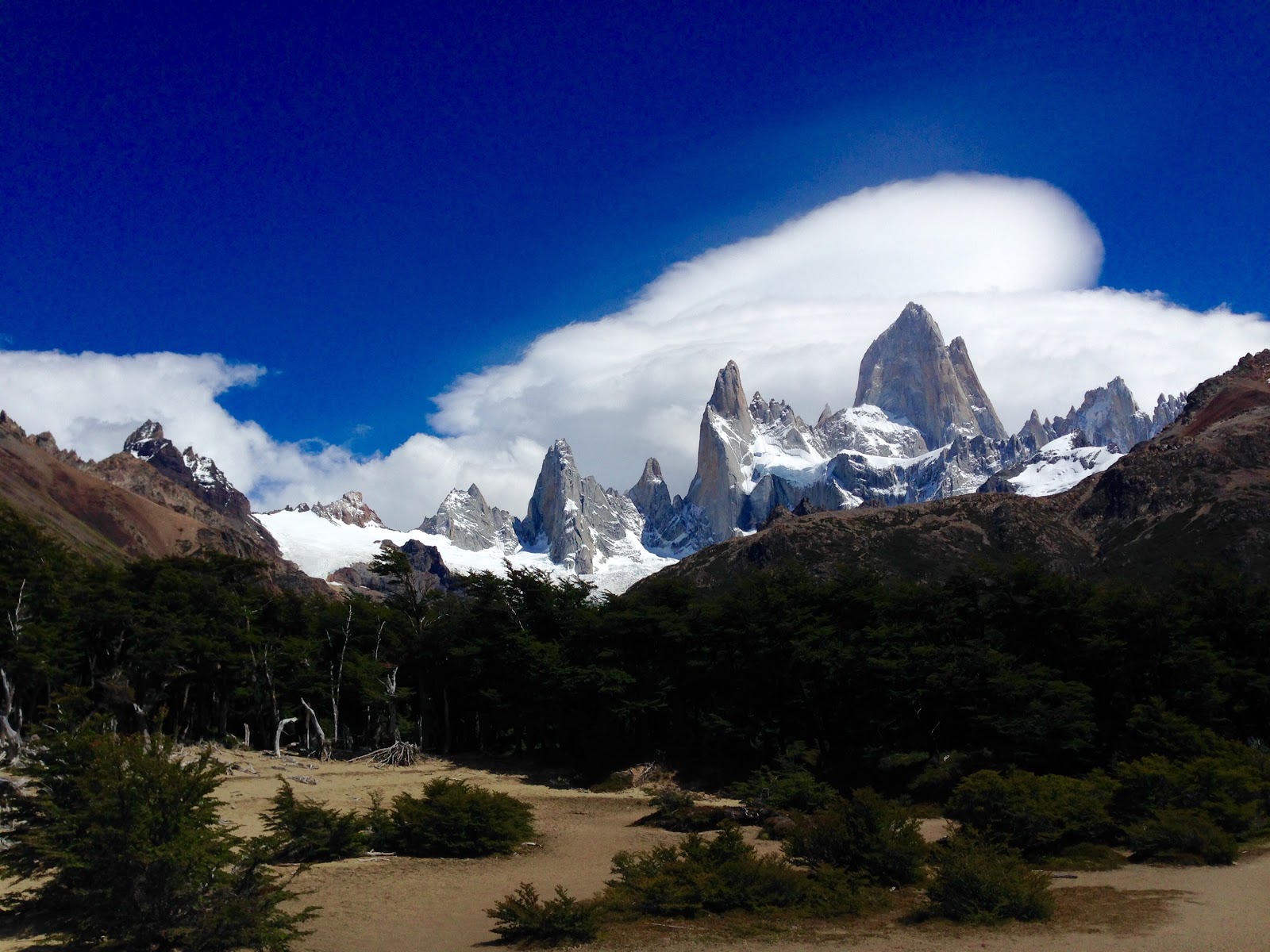
The ubiquity of ‘el viento’---the wind characterizes Patagonia. Its harsh and rough hand has torn at crags and the up thrusts of granite faced mountains exerting dominion and carving its presence in geological time.  That sculptor accompanied by the kindred spirits of rain and snow, hot and cold has left rugged peaks jutting into clear blue skies hung with cumulus clouds reflecting off glacial blue lakes that shimmer as the hand of 'el viento' plays across their surface.

The rivers snake over endless empty plains, llano that hosts ground cover weathered and ruggedly  adapted to the wind and elements. Most plants cling low to the ground and the majority of them present spikes and thorns to the outside world.  Even Patagonia's horses are wary of galloping off trail and encountering this natural resistance. Barren miles of dun colored earth stretch out unyielding in its expanse and enormity of distance, humbling the traveler.

The population centers like El Calafate are oases in between.Travelers flock there either for companionship, provisions or places to share their tales of conquest of the terrain in the vicinity.  A hike to a refugio is a badge of honor earned by putting one foot doggedly in front of the other and pulling your weight uphill. Most popular hikes are to a lake at the base of a peak, an overlook-mirador that presents stunning views of unparalleled scenery, or on a circuit up and through mountain peaks that requires hiking long hours and camping in cold, rain or blowing dirt.  Rarely is the earth still and not assaulting intrepid travelers.

The people are generally kind, laid back but industrious, well educated and proud.  They are mostly of European extraction having decimated the indigenous population early on with European disease that they had no wherewithal to fight. Spanish, Italian, German, Irish immigrants have peopled this land making it somewhat like visiting a geographically immense Europe that speaks various dialects of Spanish.  At its core the language is Castellano.  Dialects vary by region.  A strong middle class thrives here with lots of small businesses from kioscos---small candy shops, tiendas selling fruit, food, queso, vino, groceries, ice cream- both sheep and cow milk


lavanderias,  restaurants, hotels and automobile repair shops. One of my favorite words for a business is ‘ferreteria.’ While Rob insists it is a place to purchase ferrets, the locals go there for hardware.


So some highlights of this place.  While El Chalten the National Park in Southern Argentina, Patagonia was our first major mountain hiking experience and am impressive National Park, my favorite was the more expansive Torres del Paine National Park across the border and South into the Chilean Andes.  We stayed near the southernmost Park entrance and luckily booked a car for 5 days to allow us the opportunity to explore this huge National Park with spectacular views.  The character of these mountains reminds one of a much younger Rocky Mountain National Park.  It is huge is scope and distance and demands either transport that you hire in Puerto Natales – the closest town which is 2 hours away, or the kindness of others if you are patient enough to thumb the journey to trail heads and boat embarkation.  The glaciers are still alive and well there though melting rapidly as are all our glaciers and their run off feeds the crystalline waters of the rivers and lakes that course down mountain canyons and through watersheds to find its way to the glaciated river valleys below.

The abruptness of the upthrust of the mountains from valley to mountain top is awe inspiring much like that of the Rockies upon first viewing them from the flatness of the Plains.
These peaks are undaunted and defy weakness.


Friday, January 27, 2017

Torres de Paine, Chile

Torres del Paine- January 26, 2017


Sunlight glints mirror-like off glaciers melting between jagged peaks reaching up to penetrate the clouds. Cumulus puffs dance atop and then descend down mountain valleys.  No amount of words can describe the beauty and majesty of these mountains that rise up from the grassy plains and rocky foothills to tree covered ridges before yielding to snow then ice that never melts tucked in the crevices and contours of these serrated peaks.


Early man that found his way down to these wind blown valleys and mind blowing mountains of Patagonia did not wear clothes. Hard to imagine when on a good day you can experience all four seasons but rarely does it get warmer than 60 and almost always the wind blows fiercely.  When it rains before it turns to sleet, depending on your elevation, the wind can send these drops horizontally to penetrate cold to the bone.

We hiked for 5 hours in wind yesterday, of which for 4 hours, we were accompanied by rain driving fiercely into us, pelting in its attack. Our destination was Campo Italiano, a typical round trip of 5 hours once you are dropped by the catamaran that delivers you to the other side of Lago Pehoe and Refugio Paine Grande. From there we started hiking.  The ascent is gentle compared to typical Patagonian ascents and runs up and down around a lake from where we could see literal swirls of water being carried upward by the wind, whirlwinding across the lake.

An American hiker did not have the proper appreciation for the wind here and unexpectedly started a fire back in 2008 that took the tree cover out, so we hiked through stands of dead timber parched white by the winds, an eerie but interesting foreground to the rugged peaks in the background. . .our destination was over the tree lined ridge that hosted Campo Italiano, said to be one of the most beautiful camps in Chile.

The clouds descended so that by 2.5 hours in we had lost all visual contact with the mountains ahead and could only see grey heavy clouds as we finally gained the trees that had been saved from the fire.  At this juncture the point of going to Campo Italiano which was just beyond, for the views was mute.
The rain had penetrated all our rain gear and my cold which has stuck with me for almost 3 weeks made me fear pneumonia, so we turned around and hightailed it back down the trail for a 2 hour walk back to the catamaran landing.  Needless to say we were wet and miserable but glad we had the views we had on the outset of our hike.

While we were standing in line for the boat at 5pm, having arrived on the 11am boat, we chatted with two guys,  one in gym shorts, who were cold and wet and joking with each other.  It turns out they had gotten up at 4am and with no packs had left the northern end of the fabled W hike and walked/ran the entire 26 miles to arrive at the catamaran landing for the 5pm boat.  It was amazing, unbelievable that anyone could do that intense a hike which usually takes 4-5 days, in one day.  One of them was a doctor getting ready to do his residency program and the other one worked for Disney.  They have been friends since high school.  We saluted their crazy achievement and watched them fall asleep immediately on the half hour trip back to the boat landing at Salto Grande, heads lolling with bone tired weariness.

We are pacing ourselves for one more hike tomorrow, estimated to be a round trip 9-10 hour day up to the far Northern part of the W where most people who have permits to camp along the W start their North to South hike.  They call the 4-5 day hike the W because it traces that letter more or less around the peaks and through the mountains from north to south in Torres del Paine.

You see about 90% of the visitors hiking here are young, agile, fuerte twenty and thirty somethings. The remaining 10% are folks like us from all over the world who have the time and have earned the mountain trail hiking temperament to attempt to continue to foot one foot in front of the other, uphill over rocks and roots that test your agility, ascents that take your breathe away literally, and bone jarring scrambles. Those still agile enough to use their legs as vehicles of transport defy the creakiness of knees or the old sports injury that wants to continually talk back.  Us “retirados” who refuse to retire to a rocking chair continue our headstrong tenacity upward, over, around and threw to whatever destination we aspire.


Wednesday, May 25, 2016

Borneo Bats, Deer Cave and Slip Sliding Away on Mountains of Bat Guano

Borneo Bats, Spelunking and Slip Sliding Away on Mountains of Bat Guano

Spelunking in Deer Cave- Mulu National Park-Sarawak
The whole idea of this family vacation was to meet Erik halfway through his one year world travels.  We thought it might be a great opportunity for a family vacation and to spend some time getting to know Kellyn, Erik's fiancĂ©. I pulled out the Marriott stay points for a decadent abode in the jungle (as there were very few options other than homestays and we were 5 people. )  We picked up Kellyn in Kota Kinabalu the capital of Sabah, Malaysia and flew to Sarawak to Gunung Mulu National Park, probably Marriott's most remote location in the world. It is surrounded by rain forest and a handful of indigenous people.

Once there our  three millennials planned the National Park activities with  a very challenging caving spelunking day, a tree top walk above the rain forest and some walks on the floor of the rain forest.  We booked a guided tour of Deer Cave called The Garden of Eden walk through one of the largest caves in the world that went from 9:30am to 7:30 pm. Our guide was a wiry thin, fit Malay man who soon pointed out a viper in the trees above our heads and lead us through the rain forest trailed by a novice young,stout, female guide of Irish and Malay descent.

The walk starts through the Gunung Mulu Rainforest and you enjoy the flora and fauna along a boardwalk trail.  Believe me much better than trying to make your way through the forest floor.


 A great variety of bugs, ants, caterpillars and other insects inhabit the rainforest.  The bats feed on them when they come out at night for their rain forest dinner menu.

 Poisonous Viper luckily high up in a tree.  If we were walking on the ground we would never have spotted it.


The five of us headed into the rainforest we had strolled through the prior day on our way to Deer Cave.  The only entry into this cave is with a NP guide as the cave presents many  physical and mental challenges and houses about 5 million bats.
 Entrance to Deer Cave one of the largest bat caves in the world.  It is about 20 stories high.  Look at the black hole above Rob's head and you will see the entrance.


Rob, Jenny, Kellyn Johnson ( soon to be Wardell) and Erik Wardell
Once in the cave, with headlamps on and your sure footed awareness heightened, before you know it you are off the board walk and moving across and climbing slippery rocks rimmed with mountains of bat guano.  The cave is dark and the lights from our headlamps the only illumination.  We gingerly make our way trying not to put our hands down too often because of the certainty that they will rest in bat guano.  In between boulders strung with ropes pitoned to the rocks we  hold on and manuever our way across the boulders, up, down, around and through.
Rob dropped his camera twice.  The second time it fell in a stream and
didn't make it.  
Boardwalk soon runs out and you are crawling over rocks and terrain covered with bat guano from millions of sleeping bats!

Finally reach the other end of the cave and come out to the Garden of Eden Valley

 First you slip slide on bat guano covered rocks then you slip slide on the river rocks in the stream that runs along the bottom of the cave.  This is a STRENUOUS trip only for those very fit and capable.  The rangers don't emphasize that enough!!!


Luckily I have been working out daily, so this was more a psychological challenge than a physical one, although it was plenty physical in the heat and dank mugginess of the cave.  Finally after not falling down into the cavern depths by hanging on to the ropes, crawling and climbing, we came to an opening and the other end of the cave and saw the river that runs through the cave floor. Here we had to choose between swimming the river or crawling up and over more rocks. Kellyn and I choose the river which seemed clear and cool.  We waded into the suprisingly clear waters that came up to our neck.  The guide took my guano covered backpack up and over the rocks and met us and the rest of the party on the other side of the rocks.

It was so refreshing just rinsing off some of the bat guano and sweat as we swam through the river.  I had to do a mind set readjustment about the guano because of course things are what you make them.  The guide offered his hand to help me through a particularly slippery rocky area.  I was originally circumspect about offering him my guano covered hand but that did not last long. Soon I was no longer worried about where the shit landed and focused on  trying to stay on my feet and keep up with the flow of the 7 of us through the cave to the far opening, called the Garden of Eden Valley.  I guess after one has come through and crawled over the slippery, guano covered rocks, swum the cave rivers, walked along incredibly slippery rocky stream beds where 'small rocks, small rocks' is the keyword for safe foot placement, and survived not falling into the depths of the cave, not  getting stuck in the rock crevices, then anything can legitimately be called 'The Garden of Eden."  This forested waterfall area accessed after one emerges on the other side of the cave requires climbing up slip slidey muddy hillsides, holding onto tree roots for sure footedness and sliding through muddy underbrush.  When we finally reached the waterfall it was a much needed break.  I relaxed for a few breathes only to remember that we had to return the way we came to get back out of the cave and back to safety.


We all washed our hands in the clear waterfall pond and ate our NP provided chicken lunches glad to sun on the rock and watch Jenny swim in the pool and Erik take pictures of Kellyn who as always graciously modeled for him.  Rob and I quietly applauding our 'Bolder Boomer' capability of hauling our butts over guano covered rocks and through rivers to get there.  By this time Rob had fallen in the river twice and the 2nd time his camera got immersed enough that it did not make it out workable.  So we sacrificed his 10 year old Nikon to the cave and got over it.  Jen and Erik took enough photos for all of us. 

I thought I had psyched  myself up for the return journey without Xanax when  our young female guide headed in a new direction down into  a small hole just large enough for a body into the depths of the cave for our return.  Yikes, I was not ready for going down, down,  down into the rock crevices and not seeing the light of our exit.  I really had to 'get it together, keep it together' to not freak out on this part.  I was never so happy to see guano covered board walk in my life when we finally crawled through rock crevasses and  hit it, ready to leave  the cave depths behind.  By this time it was only 3 pm and we still had one more cave to go to before going to sit outside of Deer Cave and watch the 3 million Borneo bats emerge at sunset for their evening feed of forest insects.  I was not keen on doing a second cave having survived the first, but sucked it up and it was actually very interesting, stalagtite and stalagmite formations in the other cave.  This time it was all boardwalk and no spelunking so it was a breeze.  We were so glad to get back to the cave entrance to finally sit down and await the awakening and emergence of the bats who had so kindly slept through the day during our travels through their homeland.  We did our part though  and did not blare Jimmy Hendrix at them to awaken them from their slumber. 

Upon reflection bats are amazing and they do get a bad rap.  They did not bother us at all during our caving expedition.  They slept and outside of their guano droppings ignored us.  They keep to their own colonies and have very systematic behaviors for sleeping and eating.  One of the most amazing natural experiences I have ever seen is their wave like migration out of the cave in black speckled spirals with a whirring of their wings speeding them on their way like a ribbon of black into the rain forest to feed.  All 3 million bats emerge colony after colony in waves for about 30-45 minutes starting near sunset. It  is truly a terrific sight and a natural wonder.

We took videos of their iconic flight and the rain held off until they were gone and then we walked back about 50 minutes through the rainforest in the dark and steady rain to the chirps of insects, whoops of frogs and warble of birds also getting rained on in the night forest.  Between our headlamps and the periodically lighted path we made it back to Park headquarters in time to have dinner at the cafeteria before they closed at 8pm.  What a day.  I have to say I am so proud of all of us for doing this amazing adventure and especially me as it was definitely a mind over fear that allowed me to suck it up and go for it.  

So when Rob and Jen decided to do the canopy walk early the next morning I opted to roll over and enjoy the sumptuous sheets of the Mulu Marriott where we had so happily spent our Frequent Flyer points for 5 nights in this great National Park.  It would be followed by weeks of various backpacker guest houses and huts, lacking the sybaritic appeal that the Marriot afforded.  When they returned from the canopy walk, they assured me that I had made the right decision for the height sensitive, anxiety disorder person that I am.  They enjoyed it and I enjoyed not doing it especially after I talked with another 66 year old English woman who had done it and had admitted to being  fairly petrified most of the time.